
Why GAM Publishers Are Turning to ProOps Ads Tracker for Effortless Reporting and Alerts in 2026
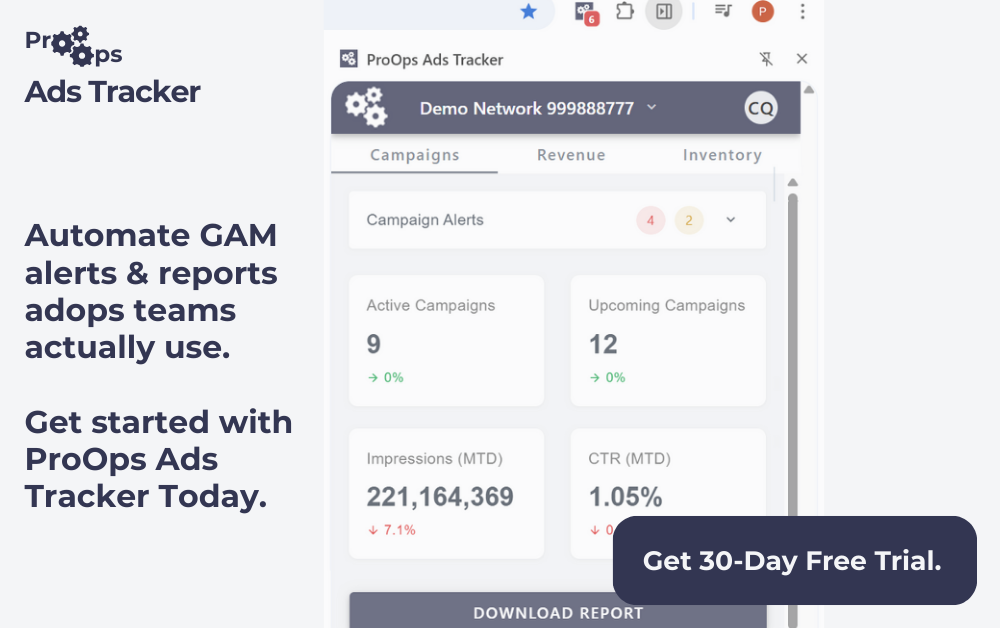
If you're a publisher monetizing through Google Ad Manager (GAM), the morning routine is all too familiar: logging in, pulling reports, scanning for under-delivery, inventory drops, or revenue dips - before they become costly problems. In 2026, with programmatic demand surging, fill rates under pressure (average 65% per recent audits), and privacy/compliance demands intensifying, manual monitoring is no longer sustainable. Publishers are turning to ProOps Ads Tracker - a read-only Chrome extension that automates GAM reporting and delivers actionable daily alerts - for one simple reason: it saves hours, prevents revenue leaks, and pays for itself quickly.

How to Automate Google Ad Manager Reporting and Save Time: The Publisher's Step-by-Step Guide (2026)
If your team's morning still starts with the manual GAM pull, this is the guide to end it. A step-by-step walkthrough of how publishers automate Google Ad Manager reporting to save time - what automation actually covers (reporting, alerts, and beyond), the three ways to do it compared, how to connect safely with a read-only service account, and the 4-6 hours per person per week most teams get back.

How to Identify and Fix Bottlenecks in Your Media Operations Workflow in 2026
As programmatic complexity rises and privacy changes tighten, publisher media operations teams face more pressure than ever. Many still rely on manual processes in Google Ad Manager (GAM), leading to hidden bottlenecks that drain time, reduce yield, and risk advertiser trust.
Common signs of bottlenecks include:
Teams spending 30-40% of their day on repetitive reporting
Issues discovered 3-5 days late (after revenue is lost)
Slow campaign SLAs (e.g., 48+ hours setup)
Reactive firefighting instead of proactive optimization
Headcount growing almost as fast as revenue, compressing margins
In 2026, these inefficiencies cost publishers $70K+ annually in labor for a typical 3-person team and $96K–$300K in preventable revenue leakage. The good news? Most bottlenecks can be identified and fixed with systematic audits and lightweight automation.
The Hidden Costs of Manual GAM Reporting in 2026
As we move deeper into 2026, programmatic complexity continues to rise - more demand sources, privacy changes, and tighter budgets. Yet many publisher ad ops teams still rely on manual Google Ad Manager (GAM) reporting: pulling impressions, fill rates, revenue, and pacing data every morning. What looks like a routine task hides significant costs in time, accuracy, and lost revenue. At ProOps Consulting, we've seen these hidden drains add up to 10-20% of preventable yield loss across audits.

The 2026 Publisher Survival Checklist: 8 GAM Settings That Leak Revenue If You’re Still Checking Manually
As 2025 winds down, publishers are gearing up for a tougher 2026: tighter budgets, rising programmatic competition, and zero tolerance for revenue leaks. If your ad ops team is still manually scanning Google Ad Manager (GAM) reports every afternoon, you're likely missing silent killers - misconfigurations that drain 10-25% of potential yield without a trace. Here's your 8-point survival checklist to audit and fix them before January hits.
Lock in Your 2026 Ad Ops Budget Now: The One Line-Item That Pays for Itself 20x
If you only add one new line-item to your 2026 tech budget, make it this one: ProOps Ads Tracker.
As directors and VPs finalize budgets in these final weeks of 2025, you're likely scrutinizing every expense for low-risk, high-impact returns. Finance and RevOps teams are prioritizing tools that deliver immediate ROI without complex integrations or steep learning curves. ProOps Ads Tracker fits perfectly - it's a Chrome extension that automates daily Google Ad Manager (GAM) reporting and alerts, freeing your ad ops team from manual drudgery while highlighting potential revenue risks.
The Ad Ops Report Card: Grade Your GAM Setup in 10 Minutes
It’s December.
You’re closing the books on 2025, building next year’s budget, and quietly hoping the same revenue leaks don’t follow you into 2026.
Before you sign off for the holidays, take this brutally honest 10-question report card. It takes less than 10 minutes and will tell you - in plain English - exactly how much money your current Google Ad Manager workflow is leaving on the table.

ProOps Ads Tracker vs Doing It Yourself: The Full Cost & Time Comparison No Publisher Can Afford to Ignore
Every week I still hear the same line from publishers:
“We’re fine. We’ve got a solid spreadsheet, a few scheduled reports in GAM, and the team checks everything in the afternoon.”
Then I ask one question:
“How much guaranteed revenue did you lose last month because an issue was missed on Friday afternoon or buried in a 400-row export?”

7 Reasons Your GAM Campaigns Are Under-Delivering (And How Daily Alerts Fix It Forever)
If you manage Google Ad Manager (GAM) for a publisher in 2025, you’ve seen the same nightmare on Tuesday morning:
A high-value Managed campaign or Programmatic Guaranteed deal is pacing at 65 % - and nobody noticed until the damage was done.

Securing GAM Automation: Why a Read-Only API is the Publisher's Safest Option
The need for Google Ad Manager (GAM) Automation is universally accepted by Ad Ops teams. You need daily alerts, automated reports, and streamlined workflows to stop the revenue leak and reclaim 4-6 hours weekly per person.
However, when proposing a new tool, Ad Ops often hits a wall: the IT and Security team.

The Pacing Paradox: Why 5 PM GAM Delivery Checks Always Miss the Real Problem
I. The Daily Ritual: Ad Ops Triage at the End of the Day
It’s 5:00 PM. Your last task of the day is logging into Google Ad Manager (GAM) to perform the routine pacing check. You pull the delivery report, export it to a spreadsheet, run your VLOOKUPs, and there it is: a crucial Managed Campaign or a high-value Programmatic Guaranteed Deal is sitting at 60% of its goal.

The GAM Revenue Leak: How Daily Alerts Stop Campaign and Programmatic Under-Delivery
If you’re a publisher Ad Ops team managing a robust book of business in Google Ad Manager (GAM), your primary risk isn't just fraud - it's revenue under-delivery.
It’s the moment you log in on Tuesday morning, pull your Monday report, and realize a critical Programmatic Guaranteed Deal (PMP) or a major Managed Campaign (Direct-sold) only hit 70% of its pacing goal. That lost 30%? It’s your GAM Revenue Leak, and it’s a direct hit to your bottom line and advertiser trust, whether the dollars were direct-sold or locked into a high-value PMP.

The End of Manual GAM Reporting: Quantifying the ROI of Daily Alerts for Ad Ops Managers
"What's the return if we pay for daily alerts?" is the question that decides the budget line - and it has a more concrete answer than most software purchases. This guide gives ad ops managers the payback math: the recovered-labor calculation (with the loaded-cost step most teams skip), the protected-revenue side that's usually the bigger number, a worked example for a lean two-person team, and how to verify the whole thing against your own network in 30 days.

Meet Chris Quinn: The Ad Ops Founder Automating Google Ad Manager for Publishers
In the chaotic world of ad tech, where the infrastructure is often a tangled knot of spaghetti code and every other word is a three-letter acronym (TLA) demanding translation, there are a few people who have not only survived the daily struggle but decided to build a simple map.
Meet Chris Quinn, Co-Founder of ProOps Consulting.

Stop Guessing, Start Growing: How the ProOps Ads Tracker Automates GAM and Catches Revenue Leaks
You know the drill. It's 9:00 AM, and you're staring down another day of manually pulling reports from Google Ad Manager (GAM). Impression discrepancies. Fill rate drops. The creeping feeling that you're spending more time hunting for revenue than you are optimizing it.
If your daily Ad Ops workflow feels less like digital strategy and more like Groundhog Day, it’s time to stop doing your ad server’s heavy lifting.
The ProOps Ads Tracker is the essential GAM add-on built by Ad Ops veterans to eliminate the manual grind.

Ready for A.I. in Ad Ops? Your First Step Isn't What You Think.
The ad industry is abuzz with talk of AI "Ad Factories" and advanced AI agents. Publishers are bringing media buying and ad operations in-house to gain more control. But what does "AI for Ad Ops" actually look like right now?
The answer isn't a complex, expensive platform. The first and most critical step is to implement foundational automation. This is about using technology to handle the repetitive tasks that drain your team's time and put revenue at risk. It's about empowering your team to get out of the weeds and focus on strategy.